
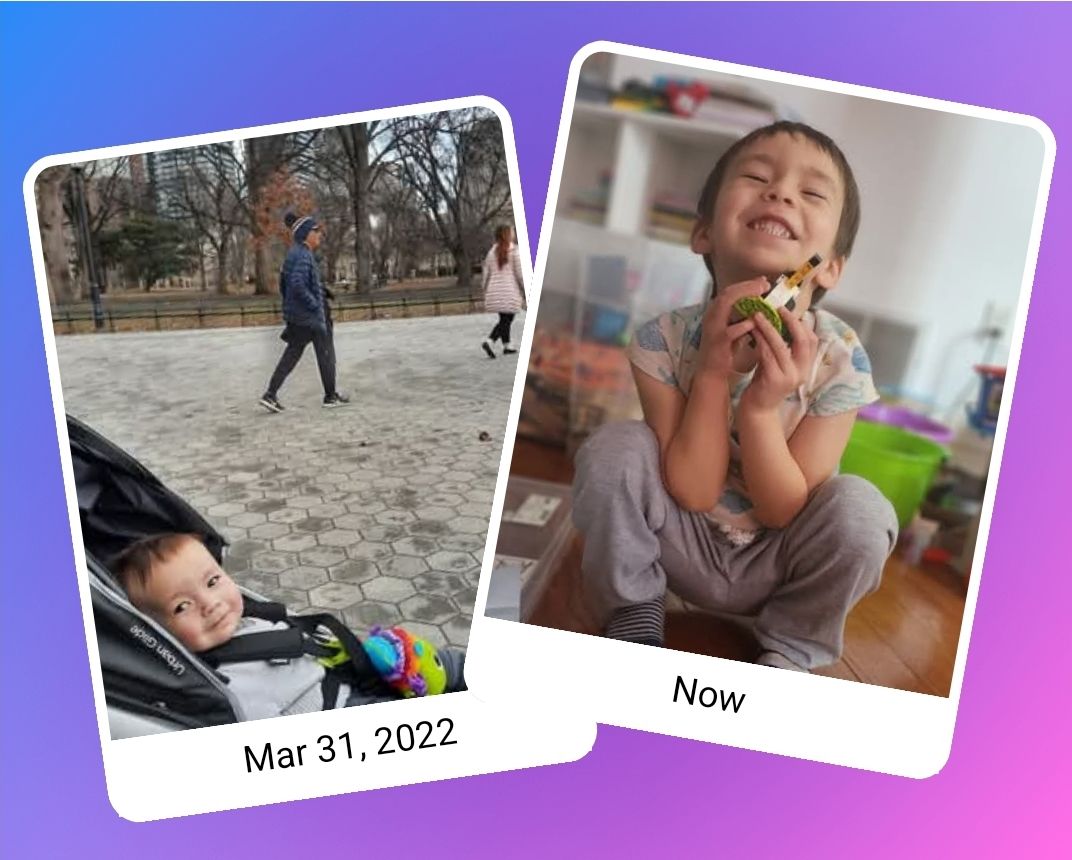
I can’t believe how fast time have gone by. I remember this day in March when we lived downtown still, and Johan and I would take walks daily after his morning nap. We were walking through U of T that day, and I remember how crisp that spring day was, golden leaves on our feet, minimal wind, and silent strangers walking past us, enjoying the day as much as we did.
A little later he woke up and we continued our walk, and at some point the rain started. I ran to an entranceway within the campus, underneath a bricked ceiling, and we waited for the rain to pass, students milling past us. It was such a perfect day and he didn’t cry once. Just yammered quietly and made cooing sounds.
Nowadays, it’s nothing but quiet 😂 He is three and asking a lot of questions and is in his WHY era. Everything WHY, WHY, WHYYYY and it’s making me question everything else as well, having to find an answer to his why’s. The easiest way I can find to describe him is that simply — he is sunlight and magic all at once.
He is mixed – half-Canadian, half-Filipino. It is both a blessing and a curse that he looks more white than he does Southeast Asian. One time while walking in Yorkville, a couple came up to me and said, “You must take care of your client so well–look at that, he’s sleeping.”
The racism didn’t hit me all at once. It wasn’t as aggressive as the man who loved to scream at me from the corner of Yonge and Bloor, telling me I had to go back to my country. Or like that one time, during COVID, when an old man held his arm out as I walked past, making sure I kept my distance, yet automatically folded it against his side as soon as my white husband walked past.
Nor did the humiliation hit my face all at once, much like it did when an elderly man asked me, as soon as my friend and I sat down to eat at a restaurant, all the way from the other side of the room, “Do you want to visit your family? I can take you back to the Philippines, I’ll pay for it!”
When I looked up, I wasn’t surprised when I saw that he was sitting with another couple. Presumably, the racist bastard was simply having lunch with his white son — and his much younger Filipina wife.
No, this time the racism came cleverly disguised as casual, light-hearted small talk–polite even, as long as you don’t dig deep enough. The racism was layered, hidden. You can almost forgive it.
Moments like these make me happy that my son won’t go through the same aggressions–he is white passing, and as loaded as that term sounds, as much as I don’t want to be a part of that ideology, I can’t help but be goddamn grateful he looks nothing like me.
Not to say he wouldn’t face any challenges. No, in today’s manosphere, his obstacles will be unique, customized especially for our time–post-COVID, digital, increasingly oligarchic, monopolistic social media society. Much like the ads we see while doom-scrolling, his problems will be targeted and tailored just for him.
Richard Reeves’ Of Boys and Men tells us what the data confirms: boys are falling behind, drowning in loneliness, losing themselves in a world that no longer knows what to do with them. I find familiarity in this. As one who has survived the cold sterility of Canadian psych wards (CAMH, Homewood, I see you), I know this is not just about “boys failing.” It is about a system that grinds tenderness into dust.
The Myth of the Monolithic Male Experience
Reeves is right about the crisis, but his solutions are timid—delay school entry, nudge boys into care work. Liberal hand-wringing won’t save my son. Neither will the reactionary poison of the manosphere, which preys on lost boys and turns their pain into hatred.
What my child needs is a world that does not equate masculinity with violence, that does not punish him for his softness.
“The first act of violence patriarchy demands of males is not violence toward women, but violence toward themselves—to sever emotional connection, to deny vulnerability, to wear the mask of dominance.” — bell hooks, The Will to Change
I sometimes think about how much Johan loves to move, wrestle, run. It brings me such pleasure, the likes of which I’ve never experienced before, when I see him with his friends, rolling around, playing super heroes, trampling each other into pancake.
They learn by moving. By touching. By laughing too loud and asking “why?” a hundred times before breakfast. But the school system doesn’t see a curious child—it sees a discipline problem.
From the moment boys enter the classroom, they are surveilled, corrected, and punished for the crime of being alive in their bodies. Black and brown boys are disproportionately targeted—suspended, expelled, funneled into special education tracks not because they are incapable, but because the system pathologizes their energy as a threat.
“Schools don’t have a boy problem. They have a punishment problem. The same behaviors that get white girls labeled ‘spirited’ get Black and brown boys labeled ‘defiant.’” — Bettina L. Love, We Want to Do More Than Survive
We don’t need more detention rooms. We need:
- Restorative justice programs that teach conflict resolution, not compliance.
- Movement-integrated learning—let boys learn through play, hands-on projects, and physical expression.
- An end to zero-tolerance policies that turn childhood exuberance into a pipeline to prison.
I will not let my son’s spark be smothered under a mountain of worksheets and behavior charts. Education should liberate, not incarcerate.
Where Can Boys Learn to Bleed Safely?
My son is half-white, half-Filipino—a child of diaspora, raised between worlds. He will inherit colonial masculinity from one side, stoic immigrant resilience from the other. Both will demand that he cut away pieces of himself to fit.
But what if, instead, we built communities where:
- Vulnerability is not just permitted—it is celebrated?
- Fathers, uncles, and mentors model emotional fluency, showing boys that love is spoken, that grief is shared, that tenderness is not a flaw?
- Care work is valued as highly as wage work, so boys grow up seeing nurturing as noble, not “unmanly”?
“We must raise boys to believe that their capacity to feel—deeply, wildly, unapologetically—is not a weakness, but the very thing that will save them.” — Gloria E. Anzaldúa, Borderlands/La Frontera
This is not just about raising better men. It’s about dismantling the lie that masculinity must be hard, cold, and domineering to be worthy.
What I’m Afraid to Admit is This:
Johan, one day you will realize that the world cannot love you as much as I do. Not with this fierceness, this tenderness.
It will teach you that your worth is tied to what you can produce, which parts of yourself you can alter and strip to monetize. That your emotions are dangerous.
That to be loved, you must first and foremost — be useful.
What I Want/Need to Show You is This:
There are many ways to be “useful”, as many meanings, as many layers. You cannot look unto others to find yourself, you MUST NOT remain merely a silhouette as you shape yourself against someone else’s form.
Instead, you must strive for solidarity, not hierarchies —
nurture care over dominance, over control —
and stay idealistic, hopeful, as enthusiastic and curious about the world as you once were when you were three years old, when you started asking why, and started saying no–
when you chose revolution every time, not resignation.
And should the world demand your surrender, you can trust your mother to welcome them.
Let them bring their hammers.
For I will strive, for as long as I can endure it, to raise you as living water that carves canyons through stone, that floods the world to reshape it.


Leave a Reply